
Lattice GAL22V10D-15QPN: Architecture, Key Features, and Target Applications
The Lattice GAL22V10D-15QPN stands as a classic and highly influential device in the history of programmable logic. As a member of the Generic Array Logic (GAL) family, it provided a powerful, erasable, and CMOS-based alternative to the older, one-time-programmable PAL devices. Its architecture, performance, and flexibility made it a cornerstone for countless digital designs in the late 1980s and 1990s.
Architecture: A Look Inside
The architecture of the GAL22V10D is elegantly structured to implement a wide range of combinatorial and sequential logic functions. The "22V10" designation is key: it features 22 inputs and 10 output logic macrocells (OLMCs), each of which can be configured as an input or an output. The core logic is a programmable AND array that feeds a fixed OR array. This structure allows users to create sum-of-products logic equations. The critical innovation over its predecessors was the output logic macrocell (OLMC). Each OLMC contains a register (D-type flip-flop) and multiplexers that can be configured to set the output as registered or combinatorial, active high or low, and with various feedback paths back into the AND array. This programmability made a single GAL device capable of replacing multiple simple PALs or dozens of standard logic ICs.
Key Features and Specifications
The GAL22V10D-15QPN's part number reveals its critical characteristics. The "-15" denotes a maximum pin-to-pin propagation delay of 15 nanoseconds, ensuring high-speed operation for its era. The "D" indicates it is fabricated in low-power CMOS technology, and "QPN" refers to its 28-pin Plastic Leaded Chip Carrier (PLCC) package.
Its standout features include:
High Programmability: The reconfigurable OLMCs offer tremendous design flexibility.
Electrically Erasable (E²CMOS) Technology: Unlike fuses, the device could be erased and reprogrammed thousands of times, drastically accelerating design prototyping and debugging.
100% Testability: The architecture supported JTAG programming and boundary scan (IEEE Std. 1149.1), simplifying board-level testing and diagnostics.
Low Power Consumption: The CMOS design made it suitable for power-sensitive applications.
High Reliability: The reprogrammable cells were far more reliable than fuse-based technologies.
Target Applications
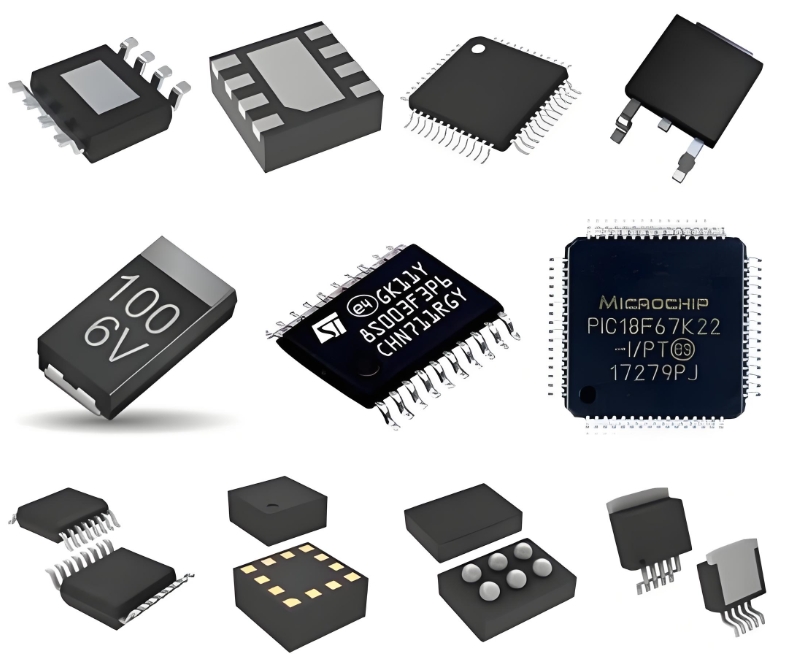
During its peak, the GAL22V10D-15QPN found widespread use as a glue logic solution, integrating multiple discrete logic chips into a single, customizable device. Its primary applications included:
Address Decoding: Generating chip select signals for microprocessors and memory systems.
State Machine Design: Implementing finite state machines (FSMs) for control logic.
Bus Interface Logic: Acting as an interface between components with different signaling protocols.
Data Routing and Gating: Managing data flow across a digital system board.
Pin-to-Pin Replacement: Directly replacing a wide range of older, less flexible PAL devices.
While largely superseded by more complex CPLDs and FPGAs today, its design philosophy paved the way for modern programmable logic.
ICGOODFIND: The Lattice GAL22V10D-15QPN was a revolutionary device that democratized programmable logic design. Its reprogrammable E²CMOS technology, flexible output macrocells, and integration capabilities made it an indispensable tool for engineers, effectively reducing system size, cost, and complexity while improving reliability. It remains a landmark IC in the evolution of digital design.
Keywords:
Programmable Logic Device
Output Logic Macrocell (OLMC)
Glue Logic
E²CMOS Technology
JTAG Boundary Scan

